How they're made
Print. Pour. Tune.
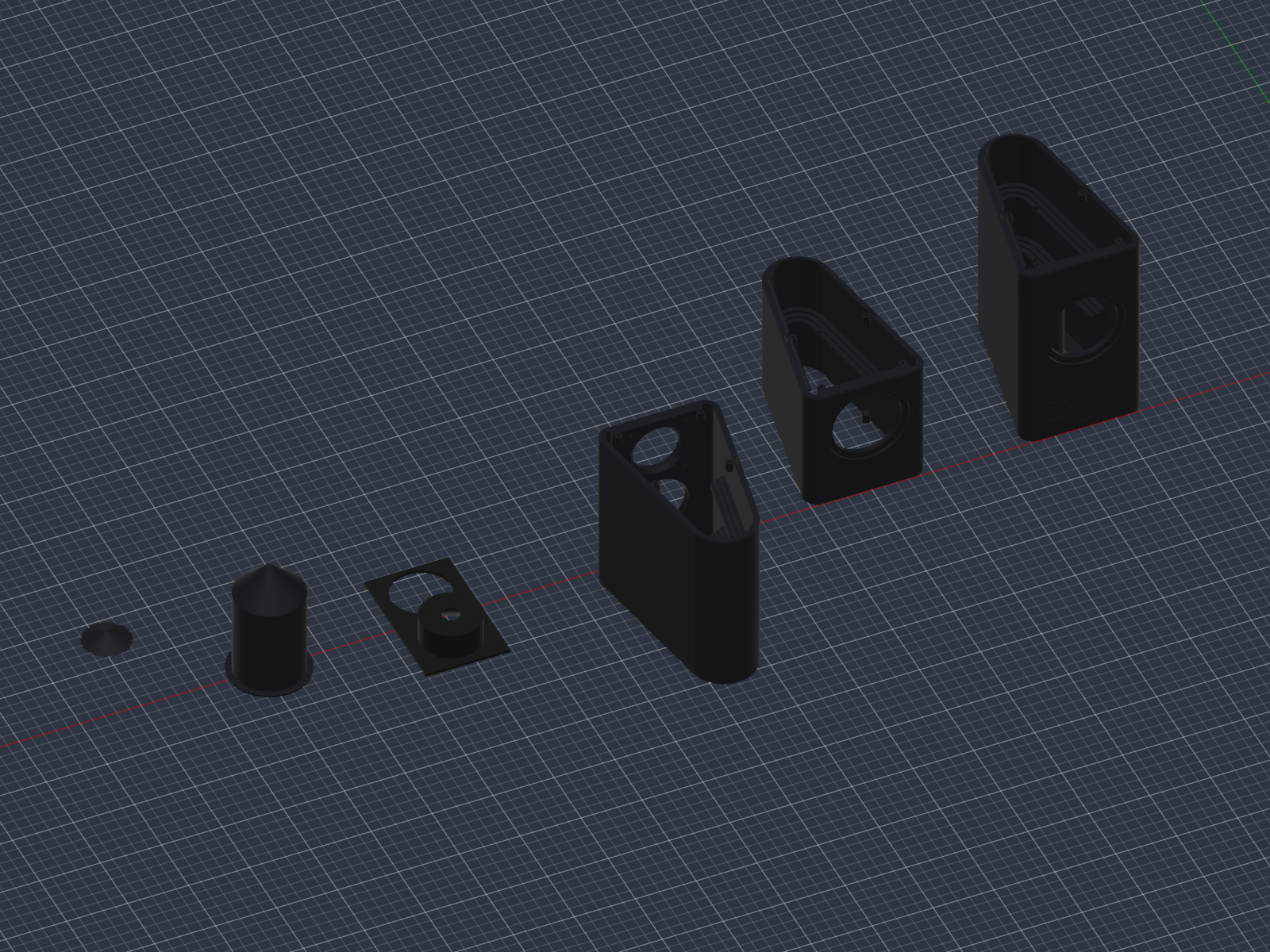
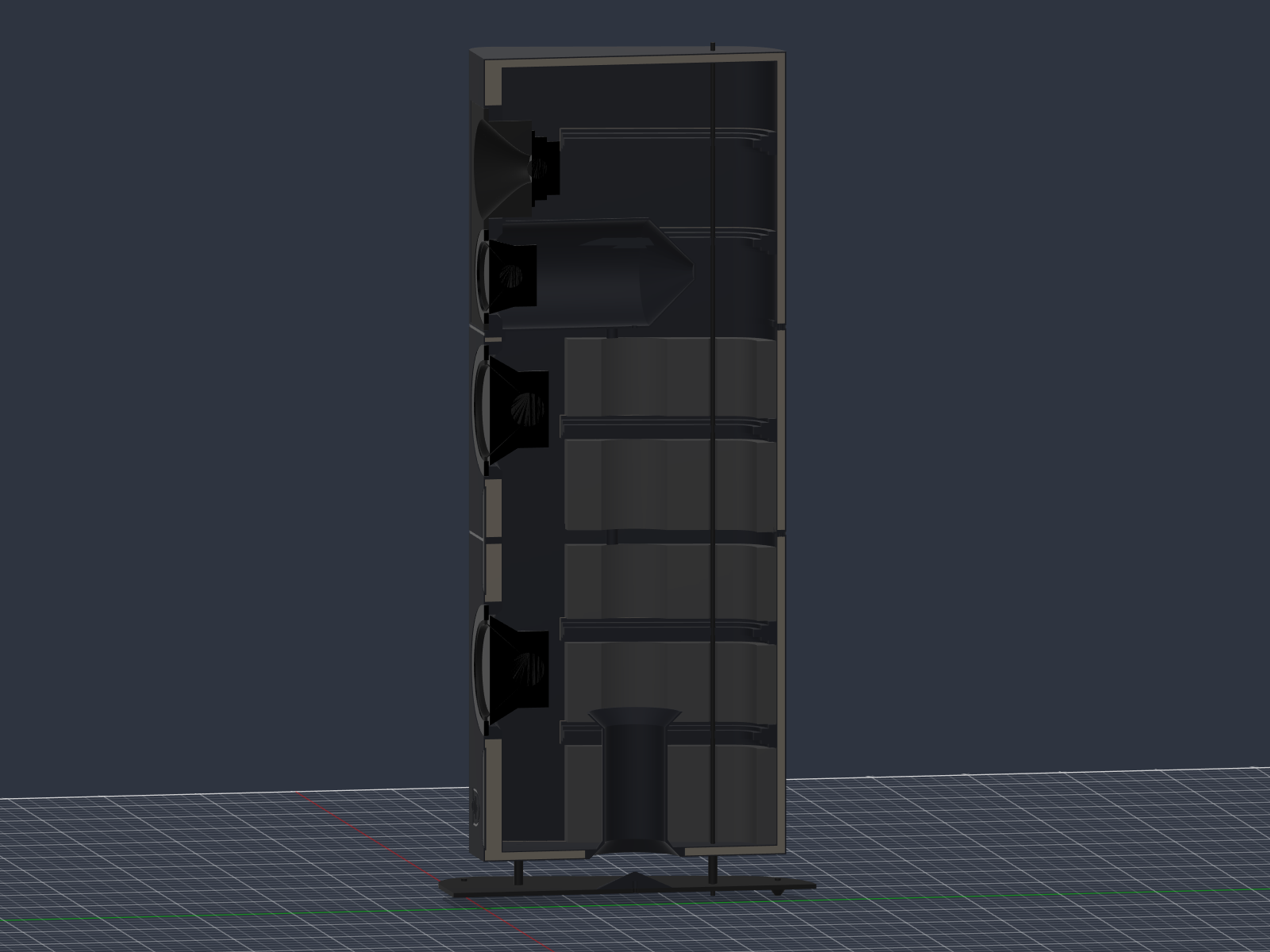
Showing how they're made is the point. Nothing here is hidden under veneer or paint. The images are renders from the design model of Tower 3, in its slim 2 × 6.5″ version; the 8-inch tower shares the build. Photographs follow the first pair.
1 · Print
Double-walled sections, printed to fit.
Each cabinet is printed in carbon-fiber PETG on a large-format printer, in keyed sections up to 500 mm tall. Tower 3 is three sections, the compact models are one. The walls print as two skins with a cavity between them, tied together by pins on a 25 mm grid. The waveguide for the tweeter grows out of the face plate as one part and prints face down with no supports.
The teardrop plan, the non-parallel walls and the ring braces inside are all things a printer does easily and a cabinet shop can't. Seams go to the rear apex, where you won't see them.
2 · Pour
Sand and resin, where the mass belongs.
Each section's cavity is filled with epoxy loaded with silica sand: 10 mm in the walls and 22 mm in the front baffle of Tower 3. That is what turns a plastic print into a tower of about 49 kg (estimated) that doesn't ring. The fill is poured in lifts and cured before the sections are assembled over steel dowels and tie rods.
The resin band is the signature. Where the outer skin stops at a joint, the tinted fill shows through as a flush band. It isn't a trim strip; it's literally the material. It is on every model, and you choose its tint.
3 · Tune
Every driver on its own amplifier.
Every Davey Audio speaker is active. Each driver has its own amplifier channel and the crossover lives in DSP, so the filters, time alignment and bass extension are set for the cabinet it was printed with, not for a generic box. The top tiers add room correction with a measurement microphone.
Power comes from a certified external supply, so there is no mains wiring inside the cabinet.

What we promise on every pair
- Section joints step under 0.3 mm all round.
- No visible seam scar on show faces.
- No stringing, no zits, no support scars.
- The resin band flush within 0.2 mm, with no voids.
- Drivers sit flush. The waveguide is smooth to the touch.
- Layer lines only where they are uniform and fine.
What we don't do
- No wood-grain filaments or stains.
- No painted "piano gloss" over prints. It shows every flaw and reads fake.
- No fake bolts, fake joints or logo stickers.
- No mixing glossy and matte plastic on one face.
- Nothing that pretends to be MDF.